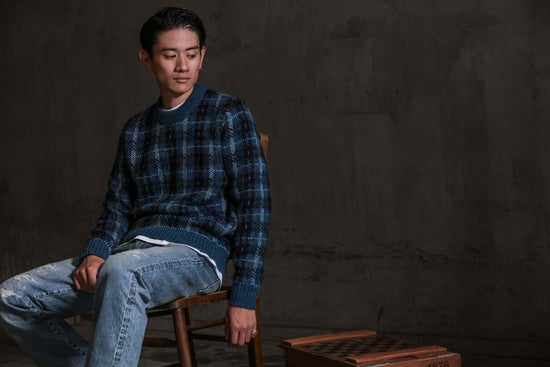
Series 400 / Zimbabwe cotton / Woven on vintage shuttle looms

+ The Denim

Zimbabwe cotton
UES sources 100% Zimbabwe cotton for its denim. Zimbabwean cotton produces a long, strong staple fibre with consistent lustre. UES works with cotton grown using fewer pesticides, and insists on hand-picking — a slower method that causes less mechanical damage to the fibres and introduces fewer impurities into the yarn.

Brown cotton weft
Both warp and weft yarns are spun from brown — natural, undyed — cotton. This gives UES selvedge its distinctive fawn-coloured weft: flip a pair of UES jeans inside out and you see it immediately. An earthy, natural backing that fades differently from the indigo warp, tracking wear in its own way.

Vintage shuttle looms
The denim is woven in a Japanese mill with which UES has a long cooperative relationship, using old shuttle looms. Shuttle-loom selvedge denim is denser and narrower than fabric produced on modern projectile looms. It breaks in gradually, developing fades that follow wear patterns with precision.

Series 400
All UES jeans use the Series 400 denim. Seven distinct cuts are offered — classic straight, regular, slim tapered, bush pants, and boot cut among them — but the fabric is consistent across the range. The cut changes the silhouette; the character of the denim stays the same.

Fading as record
UES describes their denim as an activity log. Fades formed through riding, gardening, fishing, or working are not signs of wear — they are documentation. Each pair becomes singular over time, specific to its wearer in ways no other pair can replicate.

MV-2
No. 16 weight / 7:3 Desi & Ugandan organic cotton / Brown Zimbabwe reverse / Made in Japan

+ The New Purcara Sweatshirt

Face yarn
The outer face is spun to No. 16 weight using a 7:3 blend of Desi cotton and organic cotton from Uganda. Desi cotton is a heritage variety — lower yield, shorter staple, and difficult to process — but it produces a distinctive dry, wool-like handle that conventional sweatshirt cotton does not replicate.

Ugandan organic cotton
The organic Ugandan cotton blended into the face yarn is considered by UES to be a strong pairing for Desi cotton. Compared to the cotton used in the original Purcara Sweatshirt — produced until 2023 — the Ugandan cotton brings higher quality and a stronger natural whiteness. The oatmeal and heather grey colourways sit slightly cleaner than their predecessors as a result.

Brown Zimbabwe reverse
The backing yarn is brown Zimbabwe cotton — the same cotton UES uses for the weft in their selvedge denim. It creates a warm, earthy interior with a different feel against the skin than bleached white backing, and draws a quiet material line between the sweatshirt and the brand's wider cotton logic.

Weight and texture
The combination of Desi and Ugandan organic cotton, spun from raw hand-picked fibre, produces a notably dense and bulky fabric — closer to wool in texture than conventional sweatshirting. Like UES denim, it continues to develop with washing and wearing. It is not finished when new.

Evolved from the Purcara
The New Purcara Sweatshirt is the direct successor to UES's Purcara Sweatshirt, which ended production in 2023. The upgrade is material: the Ugandan organic cotton raises the quality of the face yarn, and the finish is subtly softer, while the characteristic weight and bulk of the Purcara are retained.

details-2_e0324f6d-9883-4b3b-9ace-95e160fbcd24

+ Shop UES at URAHARA

+ Frequently Asked Questions

All UES garments are made in Japan. The brand operates a small factory where some goods are produced, and works with specialist mills — including the Japanese weaving mill where its selvedge denim is woven on vintage shuttle looms. Production is deliberately small-scale, which is part of how the brand maintains material standards.

UES stands for Universal, Ethical & Sustainable. But the name predates the acronym — it derives from the Japanese word ウエス (ues), meaning the worn rags and waste cloths used to wipe down machinery in iron foundries and workshops. The brand adopted the word to reflect its belief that garments should be worn fully, until there is nothing left. The acronym was added later as an accurate description of what UES had been doing from the beginning.

UES denim is made from 100% Zimbabwe cotton, hand-picked and grown using fewer pesticides than conventional cultivation. Brown — natural, undyed — cotton is used for both the warp and weft yarns, giving UES selvedge its characteristic fawn-coloured weft. This is visible on the inside of the fabric and produces a distinctive fading pattern over time.

The New Purcara Sweatshirt is UES's current crew neck sweatshirt — the successor to the Purcara Sweatshirt, which ended production in 2023. The face yarn is a No. 16 weight blend of Desi cotton (70%) and organic Ugandan cotton (30%), producing a dense, wool-like texture. The backing is brown Zimbabwe cotton — the same cotton used in the weft of UES denim. It is available in Black, Navy, Heather Grey, and Oatmeal.

Desi cotton is a heritage cotton variety — lower yield and more difficult to process than modern commercial cotton, but valued for the distinctive dry, wool-like handle it produces in finished fabric. UES combines it with organic Ugandan cotton in the face yarn of the New Purcara Sweatshirt to create a bulky, textured fabric that sits closer to a heavy wool knit in feel than conventional sweatshirting.

No. UES has never run a discount sale. This is a deliberate policy that reflects the brand's belief in the full value of its products. Selling at a discount would imply the original price was not justified. UES believes it is.

Yes. UES provides free repairs for their garments at both flagship stores in Japan — Osaka and Daikanyama, Tokyo. This is consistent with their philosophy that garments should be worn fully, not discarded when they show signs of use. Repair is treated as a natural part of the product's life, not an exception to it.

Didn't find your answer?

Get in touch and we will help with sizing, fit, fabric, or care advice.